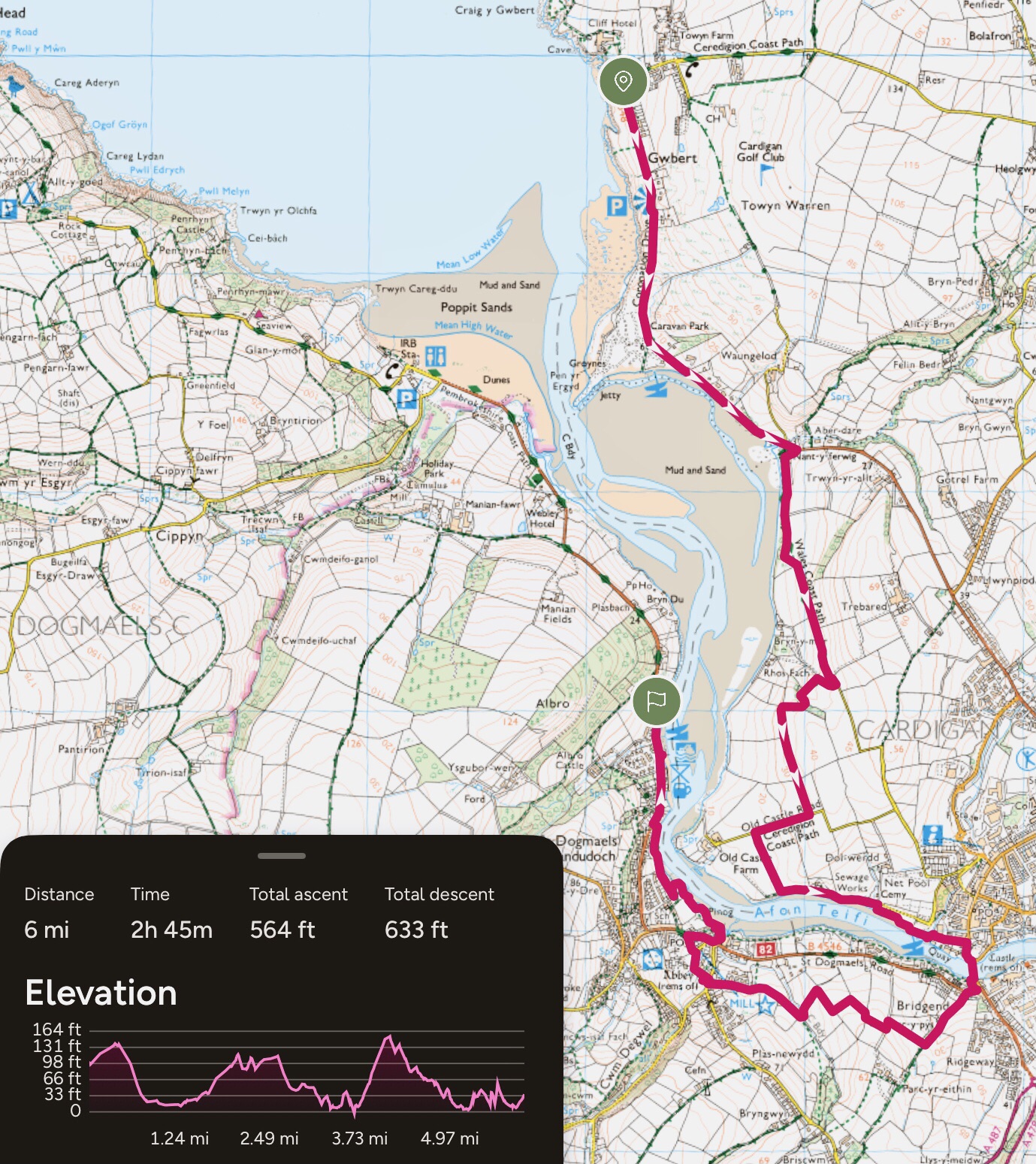
This walk starts at The Gwbert Hotel, following the Wales Coast Path south to Cardigan Town crossing the River Teifi to the village of St. Dogmael’s in Pembrokeshire. It’s a 6 mile walk, ‘point to point’.
We set out on a bright, crisp late February morning joining the coast path directly opposite the hotel, walking along the top of fields which gently slope away towards the coast with splendid views towards North Pembrokeshire.
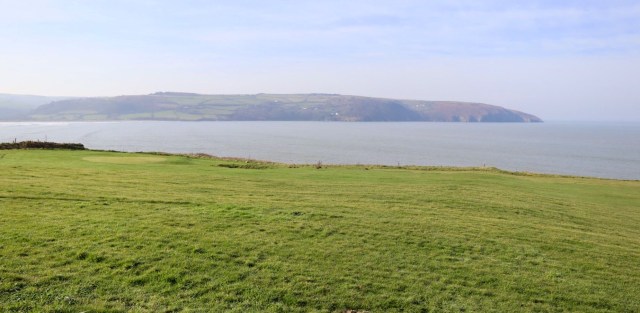
View south of Cemaes Head, Pembrokeshire.
A small car park provides a great viewpoint across the bay. Some light entertainment was provided by a family with two young children, eagerly watching the water and noisily exclaiming they HAD seen a dolphin. Their parents, using binoculars, scanned the bay intensely but with nothing to see told the kids they were mistaken. They didn’t take this too well and were still adamantly claiming “but it was a dolphin!” as their parents bundled them back into the car to depart!

We continued downhill alongside the main road until a way-marker points the way to a narrow track which emerges at an area of dune grass with a picturesque coastal scene.
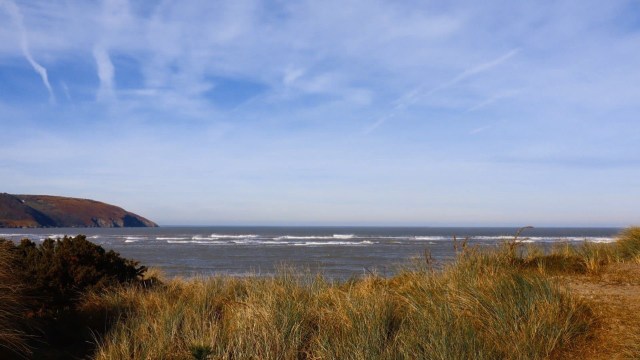 The coast path goes around a caravan park to a shingle bank near a boat yard, the only sounds on the breeze were a few boats gently bobbing around.
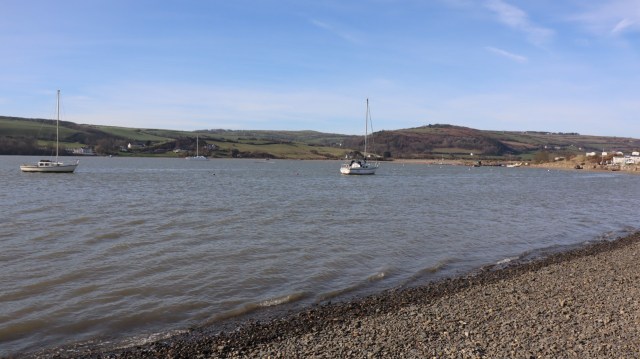 We walked up a slipway and joined the pavement along the main road, following the course of the estuary as it meanders inland near a boat repair yard.
The path becomes a countryside trail alongside the River Teifi estuary, a really pleasant section with a chorus of birdsong from the hedgerows as we crossed numerous fields.
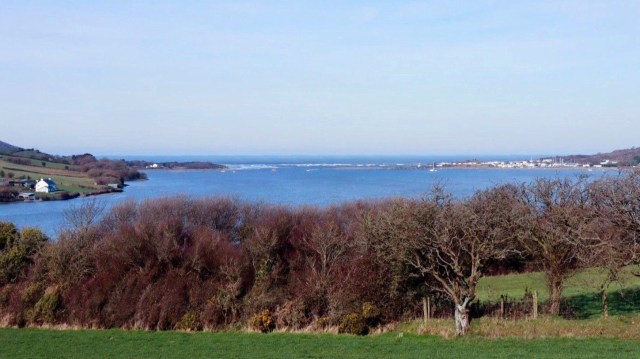
The track descends gradually through fields and eventually brings us alongside the bank of the River Teifi onto the Quayside in Cardigan.
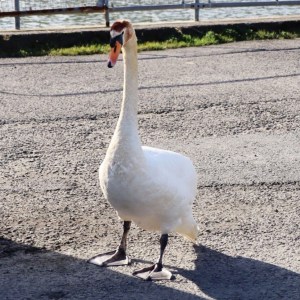
There was a lighthearted moment here as a swan was strutting confidently along the footway, providing some amusement for a few locals. We wondered if he was walking the coast path too.
We stopped off for a refreshments break here at a quirky, smart cafe, The Fisherman’s Rest. It’s an old wharf building on the riverfront and is a nice, comfortable place for a pit-stop before we continued on our way.
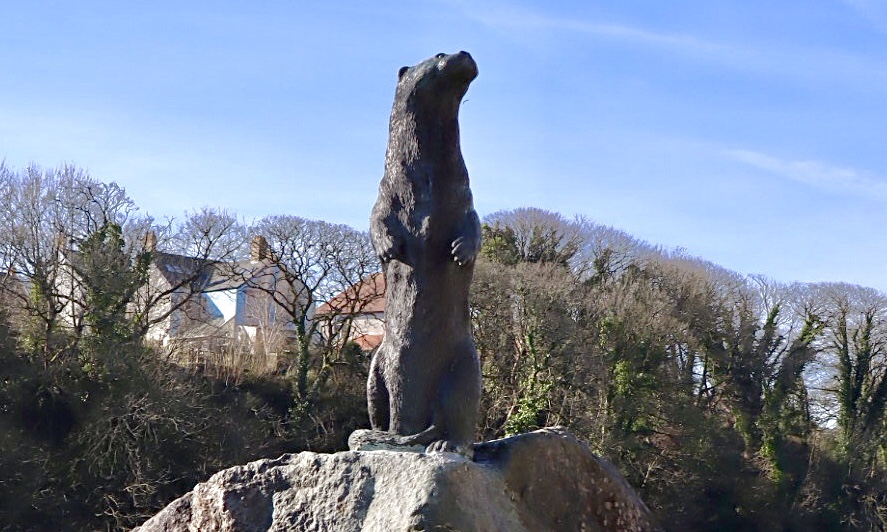
We passed the recently restored Cardigan Castle to cross the footbridge over the river. A statue of an otter sits proudly overlooking the riverside.
After crossing the footbridge over the river, there’s a choice of two routes into St. Dogmael’s, either continuing along the main road or take an uphill lane leading into countryside. We chose the countryside path over the fields.
Our boots got plastered on this section as we hiked across some very muddy farm fields, the ground heavily churned up by cattle. A highlight here was a large number of buzzards overhead as they soared and circled in the clear sky with their high pitch distinctive calls breaking the silence.
St. Dogmael’s
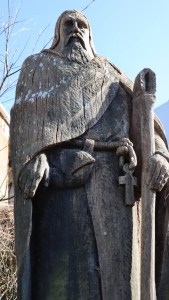
St, Dogmael’s takes its name from a 6th century Celtic saint, reputedly a cousin of St. David. A wood carved sculpture of the Saint stands next to a millpond.
Along the road are the grounds and ruins of the once substantial Abbey which was established here in 1120 A.D.
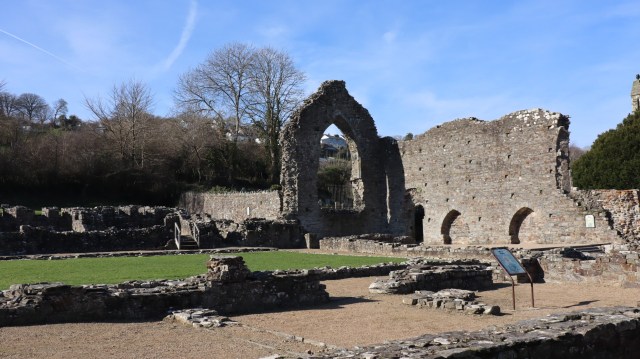
After a peaceful wander around the abbey grounds we walked to St. Dogmael’s main street and then through to an open space which overlooks a stretch of the River Teifi, where nearby can be found a very interesting natural feature.
Ancient ‘Answer Stone’
A path off the open space leads to a hollow on the riverbank, where a massive dolmen type stone is situated. This huge rock is a peculiar shape and is hemmed in by a semi-circular stonewall, on this photo it almost gives the appearance of a serpent’s head emerging from its lair!
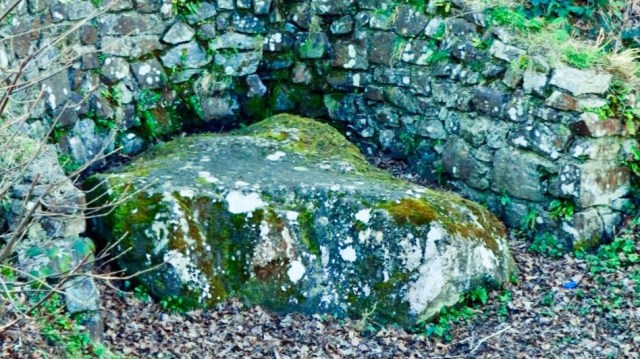
The stone is known in more recent times as the ‘Blessing Stone ‘ so called because it was at this spot the Abbey monks would bless the local fishing boats launching on the river. But an original name from earlier Celtic times is the ‘Answer Stone’ or ’Carreg Ateb’ in Welsh.
The stone is positioned in an unusual place and archaeologists speculate on why the ancient celts placed it here, perhaps over 4000 years ago, with some suggestions that it may originally have formed a capstone of an ancient burial chamber.
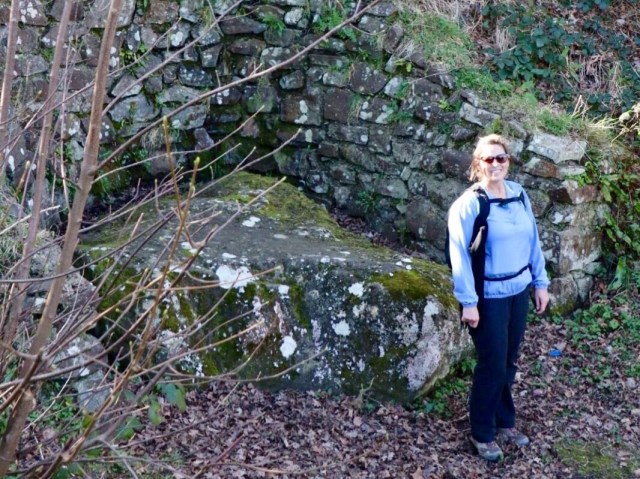
So while there’s a mystery about the stone’s original purpose, there’s some ancient Celtic magic here & the reason it’s known as the Answer Stone will become clear.
When you stand at the stone, facing the river and shout out across to the far bank, your words are echoed back, It’s an intriguing feature at this exact spot and who knew you could have such fun on a coast walk, as we shout out and our echoes rebound from across the river.
We walked on through the village along Poppit Road, lined with character cottages and stopped off at traditional riverside pub with views across the River Teifi.
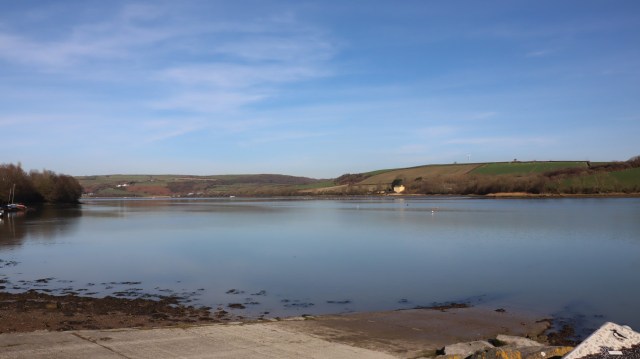
The River Teifi at St. Dogmael’s
It had been a fine day for walking with clear blue skies and warm weather. It felt like we had been on an early summer ramble, yet officially it was still winter! On a late winter hike you’d expect to seek out a pub with a roaring fire and a hot meal.
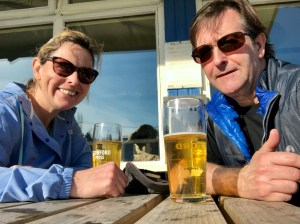
Not today though, as we enjoyed a refreshing cider outside on the riverside deck of The Ferry Inn, St. Dogmael’s.
As the pub sign states, coast walkers muddy boots are welcome!
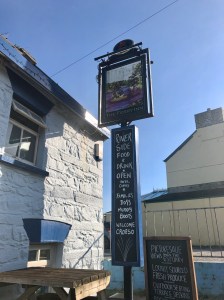
Croeso ~ A warm welcome at The Ferry Inn, St. Dogmael’s
Route Stats
This walk from the Gwbert Hotel to St.Dogmael’s ‘point to point’ is a distance of 6 miles. Return via the road route to Cardigan and pick up the coast path to Gwbert is 5 miles, so an 11 miles walk ‘there and back’.
 Short Walks Long Paths
Another detailed and informative description from Rich of a lovely walk to St Dogmaels.
Sunglasses in February ? It just shows that even in winter if you choose the right days you can enjoy a coastal walk.
Cato
LikeLiked by 1 person
Thanks Cato for the kind words and encouragement, it puts a spring in the step for the next walk. Rich
LikeLike